MACHARIA Joseph Kimunge, Kenya
Abstract (as taken from original project proposal)
Stingless bees play an important role in pollination and regeneration of vegetation. However, data on stingless bee diversity is scarce. Several challenges face bee identification such as lack of enough taxonomists, lack of reference collections, poor documentation of bee ecology, behaviour and species distribution, poor understanding of races, hybrids and genetic variability, limited expertise and laboratory facilities. The abundance and species richness of stingless bees will be studied, using standardized honey-water baiting assays. The 10 sites will be grouped in five localities varying in zones. A baiting assay consists of spraying diluted honey on vegetation along transects and recording bee arrival on the same day. Nests architecture details will be studied. Honey from different species will be analysed to determine the composition and variations in different species of stingless bees. This study will introduce economic incentives through awareness creation of their importance and their domestication that integrate biodiversity conservation with economic development.
Training location: Mr Macharia was trained in the Royal Belgian Institute of Natural Sciences (RBINS) in Brussels as well as in the Royal Museum for Central Africa (RMCA) in Tervuren. His taxon-specific tutors were Dr C. Eardley from the Agricultural Research Council in South Africa and by Dr. A. Pauly, scientific collaborator of both the RBINS and teh RMCA.
When asked how the support of the Belgian GTI advanced his career, Mr Macharia responded that the received support allowed the:
- successful completion of his Msc thesis and obtain the award of the degree;
- raise of his profile in bee taxonomy in Kenya and beyond;
- improvement of his knowledge of the diversity of stingless bees in Kenya;
- access to new technology/methodology with new collaborators and interaction with professionals in bee taxonomy;
- successful development of stingless beekeeping in Kenya for the first time;
- raising awareness among local communities about the urgency of rainforest conservation through explaining the roles of pollinators.
Selected output of Mr Macharia:
Presentations and posters
- Presenter (oral and poster): From bee hunting to beekeeping: Stingless bees in Kenya and Antibacterial activity of Kenyan Stingless Bees Honey (Poster). 41st Apimondia Congress. 13th - 19th September 2009, Montpellier, France. (The registration, accommodation and air ticket was catered by Belgian National Focal Point to the Global Taxonomy Initiative, Royal Belgian Institute of Natural Sciences)
- Presenter (oral): Stingless Bees in Kenya: Commercialization and Impact on the community. Youth Innovation Challenge and Socialization of Science Workshops. 12th-17th July2009, Mombasa Kenya.
- Presenter (oral): Topic, Stingless bees Cultures in Africa. Global Pollinator Summit. "25th to 4th July 2008, Durban, South Africa.
www.bee-bol.org/durban%20pres/Macharia%20Durban%20Presenation.ppt and
www.barcoding.si.edu/PDF/GlobalPollinatorSummitReport.pdf
- Presenter (Poster): Managing Stingless bees for Forest Conservation and Income Generation. Student Conference on Conservation Science. "25th to 27th March 2008, University of Cambridge, UK. http://www.sccs-cam.org
- Presenter (Oral): The third JKUAT Scientific, Technological and Industrialization Conference and Exhibitions. Jomo Kenyatta University of Agriculture and Technology, Nairobi, Kenya. (March, 2008)
Publications
Macharia J. K (2008). Status and Potential of Stingless Bees (Apidae: Meliponinae) for Forest Conservation and Income Generation; Case Study of Kakamega Forest. Msc Thesis Jomo Kenyatta University of Agriculture and Technology
E. M. Muli , J. M. Maingi, J. Macharia (2008). Antimicrobial Properties of Propolis and Honey from the Kenyan Stingless bee, Dactylurina Schimidti. Apiacta Journal 2008 http://www.apimondia.org/apiacta/articles/2008/antimicrobial_properties.pdf
Mr Macharia's work was also briefly covered in the October/November 2009 issue of Science Africa (page 7 & 15)
Through this training and the output of this project Mr Macharia has also been awarded:
- Young Professionals in Science Competition (Africa) award, April, 2009, Addis Ababa, Ethiopia. (Status and Prospectus of Stingless Beekeeping in Kenya)
- Capacity Building course on ‘Pollination Ecology and Bee Biology', Nairobi, Kenya. Funded by Biodiversity monitoring Transect Analysis East Africa (BIOTA-East Africa). August 2008
- Miriam Rothschild Conservation Internship award, University of Cambridge, UK and Earth and Biosphere Institute, University of Leeds UK. 28th March to 27th April 2008. (Creating computer identification system for East African stingless bees)
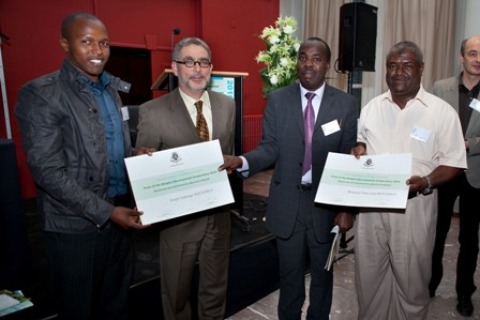
- The 2010 Prize of the Belgian Development Cooperation. Read more here.
Future plans
In future, Mr Macharia intends to start his PhD studies on Consequences of forest disturbance and climate change on stingless bees in Kakamega forest. This will depend on availability of funds or fellowships.
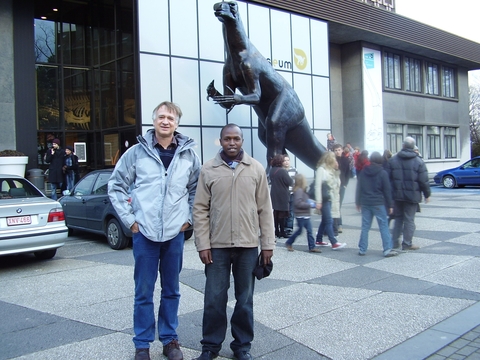
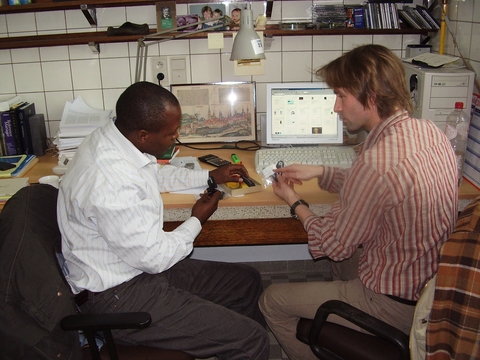
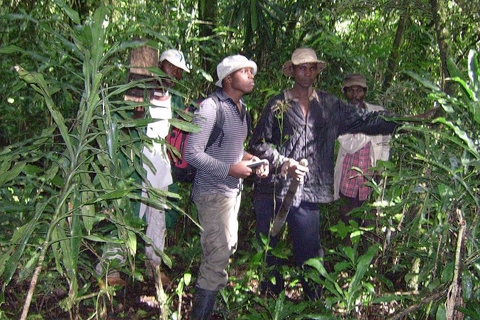
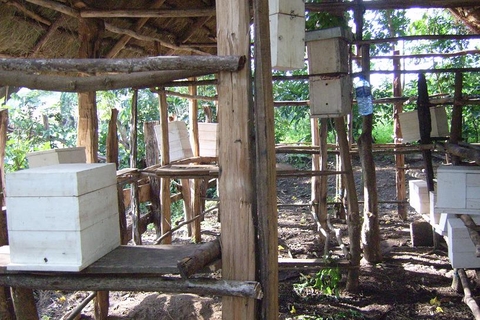
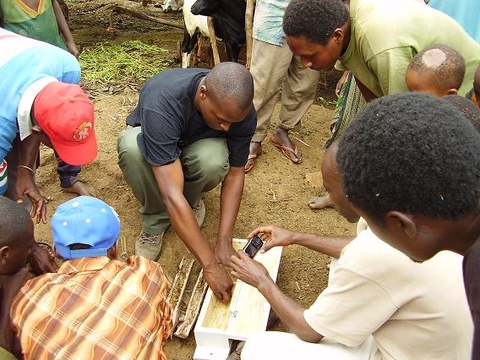

(Top row, left) C. Eardley and J. Macharia in front of the RBINS; (top row, right) J. Macharia and Y. Samyn discussing nomenclature; (second row) J. Macharia is being congratualted by the Assistant mininster of Agriculture (Kenya) after the Young Professionals in Science Competition; (third row, left) Working with honey hunters to advance stingless bees conservation, folk knowledge and taxonomy; (third row right) Stingless bees in rational hive; (fourth row, left) Training community members on domestication of bees; (fourt row, right) Stingless bee colony.
Mr Macharia won the Prize of the Belgian Development Cooperation 2010 (see picture below):