KALEME Prince Kiswele, South Africa
Abstract (as taken from original proposal)
The impacts of fragmentation include habitat loss and increased isolation with many biological effects. The Albertine Rift habitats have two main features: high biodiversity and levels of endemism, and dramatic threat to biodiversity due to high human population densities and pressure on resources. My research will explore the relationship between these mountain fragments within the Albertine Rift and the small mammal distribution as well as the geographic distribution of genetic variation associated with morphological forms. To achieve these goals, species from the genus Praomys will be used because of the current uncertainties in its taxonomy (believed to be species complexes). Data generated by Dr Verheyen’s team for the lowland north eastern DRC and in east Africa (Kenya and Tanzania) have shown the same pattern with our molecular data. This explains the need for a combined molecular dataset which will be used in association with morphometrics data.
Training location: Royal Belgian Institute of Natural Sciences, Brussels
Read more on Dr Kaleme's capacity building visit to Belgium inn his GTI report
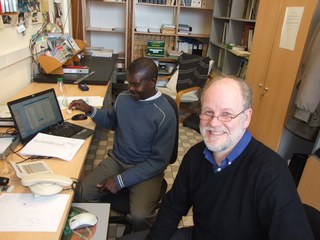
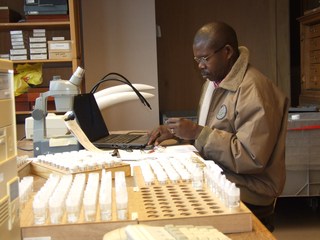
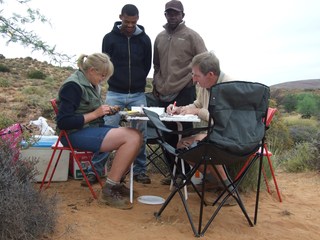
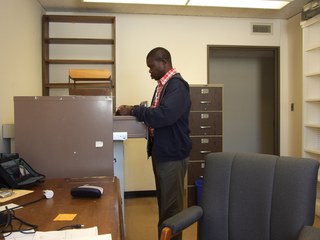
Top, left: P. Kaleme during a discussion with his RBINS tutor Dr E. Verheyen; top right: P. Kaleme in RMCA, measuring skulls; bottom, left: Setting up traps in S. Africa; bottom, right: verifying data records in the Field Museum (USA).